About Us
Honky-Tonk Time Machine
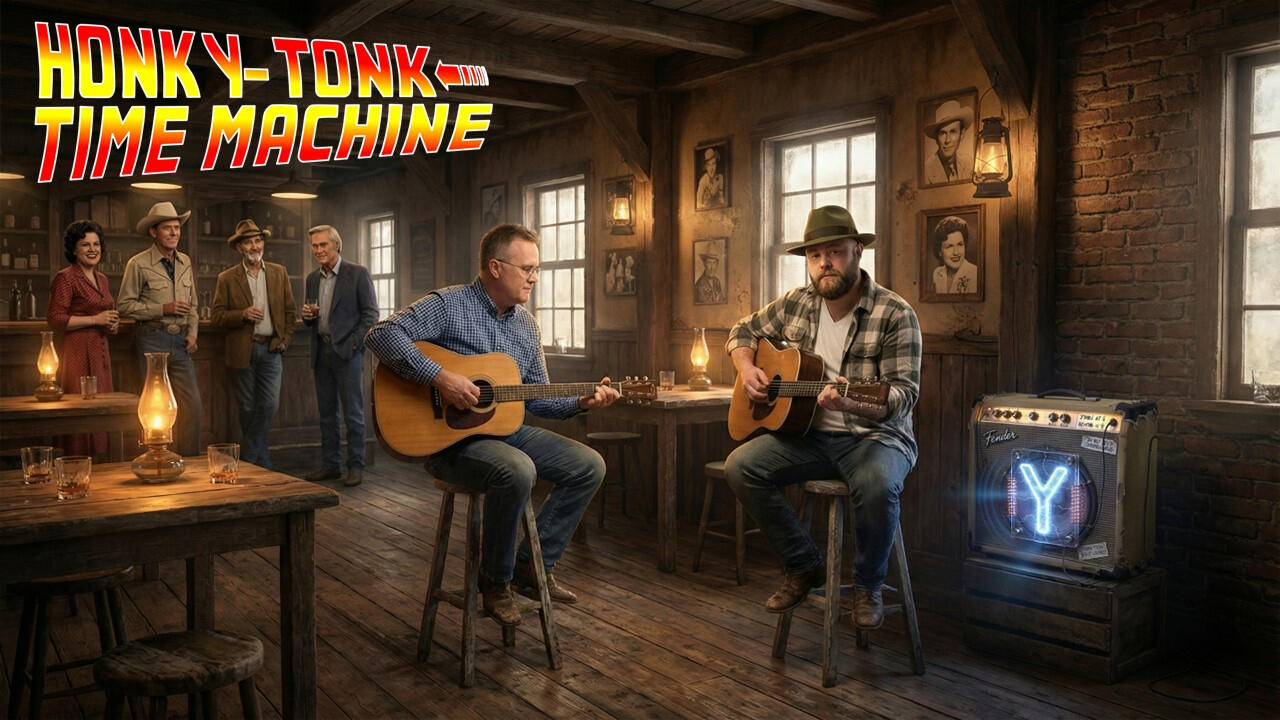
Step aboard the Honky-Tonk Time Machine and join country duo Blake Wagner and Dave Manley as they traverse through time with their classic country tunes; featuring songs from the 1970s, 1980s, and 1990s. Fueled by a shared passion for the legends of old, their harmonies and timeless melodies whisk listeners to bygone years, effortlessly transporting them through time and space. Close your eyes and let the honky-tonk anthems of the '70s conjure up images of neon-lit dancehalls while the heartfelt ballads of the '80s take you on an emotional journey down memory lane. Then, the boot stompin' hits of the '90s propel you to a rollicking country party under the starry night sky and yellow moon.
A Melodic Journey Through the Years
With each note they play, Honky-Tonk Time Machine bridges generations and kindles a deep love for the golden age of country music. Together, Blake and Dave craft musical time capsules that honor each era while creating an everlasting legacy for the future. Embark on a never-ending journey where the spirit of classic country thrives eternally and songs have the power to transport you through the ages, connecting the past, present and future in perfect harmony.
Contact Info
Email: [email protected]
Phone: 801-694-4777 (Blake) or 480-550-0808 (Dave)
Webpage: www.HonkyTonkTimeMachine.com
Calendar of Events
Saturday April 25 2026 -- 1-3 pm
North Mountain Brewing Company
522 E Dunlap Ave, Phoenix, AZ
Thursday April 2 2026 -- 6-9 pm
West Valley Country Music Association
I&J Fountain Restaruant
12221 W Bell Rd, Surprise, AZ
Sunday March 1 6 2026 -- 1 pm
Glendale Folk & Heritage Festival
Sahuaro Ranch Park - Fruit Packing Shed stage
9802 59th Ave, Glendale, AZ
Friday February 6 2026 -- 6-9 pm
Arizona BBQ Shack
8471 E McDonald Dr, Scottsdale, AZ
Saturday January 17 2026 -- 1-3 pm
Let It Roll Bowl & Entertainment Center
8925 N 12th St, Phoenix, AZ
Music and Videos
Time Travel Journal
Chapter 1. We invented time travel?
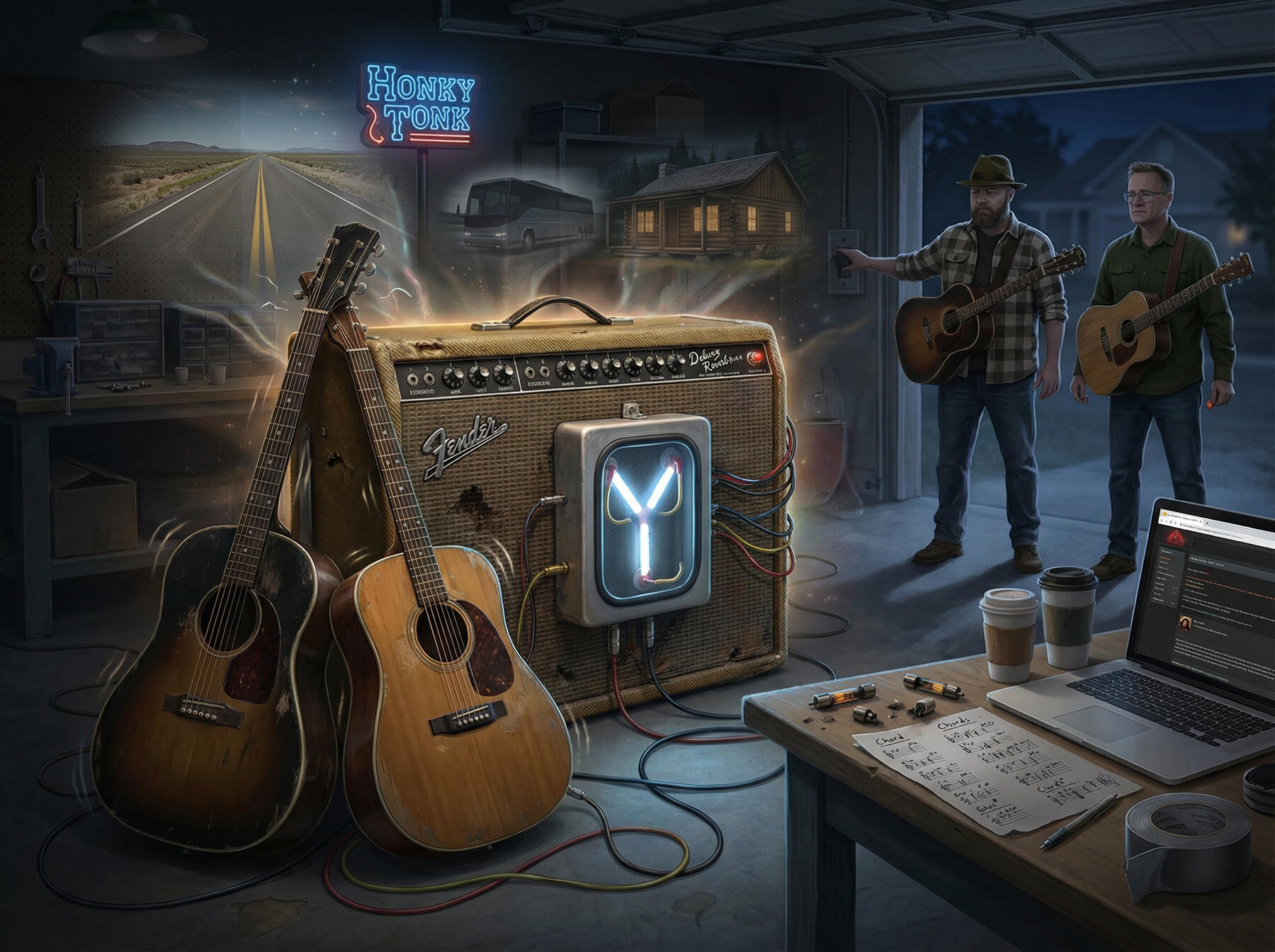
Some inventions are built on science; this one was built on three chords and the truth.In 2021, Blake and Dave weren’t trying to invent time travel. They were trying to understand why certain songs felt older than they were—why some chords carried weight that didn’t belong to the present.They were in a garage with two acoustic guitars and an old Fender Deluxe Reverb that hummed like it had stories left in it. The tweed was worn. The tubes ran warm. The reverb never went past five.Dave strummed a simple progression and let it ring.“You ever notice,” he said, “how some songs don’t belong to now?”Blake muted the strings slowly. “Define now.”“This room. This year. Us.” Dave shook his head. “Some of these songs feel like they’re bleeding in from somewhere else.”Blake looked at the amp. “What if they are?”That question didn’t get laughed off. It didn’t get dismissed. It stayed.And once it stayed, it had to be tested.They started with theory. Resonance. Frequency overlap. They wired the acoustics straight into the Deluxe Reverb. Blake dug through schematics from places musicians don’t usually browse. Dave acquired a flux capacitor—yes, shaped exactly like the one from Back to the Future. Neither of them treated it like a joke.The first trials failed.Sometimes the amp screamed and cut out.
Sometimes nothing happened at all.
Once, the garage clock skipped ahead three minutes and never corrected itself.They adjusted everything.Tube bias. Pickup height. Cable length. Even measured the sound with a handheld sound level meter, watching the decibel numbers climb and fall like they mattered.“Maybe it’s not loud enough,” Dave said.So they pushed it.The amp filled the garage. The meter confirmed it. The numbers rose. The walls vibrated.Nothing.Blake set his guitar down.“We’re chasing the wrong thing.”Dave looked at the cables spread across the floor. “Then what are we missing?”Blake didn’t answer right away. He just picked the guitar back up and played the progression again—three chords, nothing fancy. But this time he didn’t polish it. Didn’t correct it. He let it be what it was.“Remember that old country phrase?” Blake said quietly. “Three chords and the truth.”Dave nodded.“We’re treating this like it’s technical,” Blake continued. “Wires. Settings. Numbers. But country music never worked that way. It’s not about precision. It’s about intent. We’re playing it safe. That’s why it won’t move.”Dave exhaled slowly. “So we stop trying to control it.”“We mean it,” Blake said. “Or we don’t bother.”They reset.No more tweaking. No more math. No more watching the decibel meter.Just three chords.Dave locked into the rhythm without managing it. Blake let the notes ring longer than comfort allowed. They stopped performing and started saying something.The Deluxe Reverb changed.Not louder.
Warmer.The flux capacitor pulsed—steady now, not frantic. The air in the garage thickened, like it was paying attention.Dave felt it first. “You feel that?”Blake nodded but didn’t stop playing.They hit the progression again. This time with nothing held back.That’s when the garage shifted.Not violently. Not dramatically.Inevitably.The walls didn’t explode—they loosened. The air bent. Sound folded inward and became direction. Time didn’t shatter—it opened.They weren’t thrown forward or backward through years. They were placed—inside the living current of country music itself. Roads. Stages. Buses. Cabins. Back rooms where songs were written quietly and never recorded.Dave let out a short laugh, half disbelief, half victory.“It was never about how loud we played.”Blake nodded.“It was about telling the truth out loud.”They named it that night.The Honky-Tonk Time Machine.Built from an old Fender Deluxe Reverb.
Two acoustic guitars.
A flux capacitor.
A little information from the wrong corners of the internet.
And a lot of failed attempts.It doesn’t respond to volume.
It doesn’t respond to technique.It runs on three chords and the truth.And when you mean it—Time listens.
Chapter 2. Waylon Jennings vs. The Nashville Sound
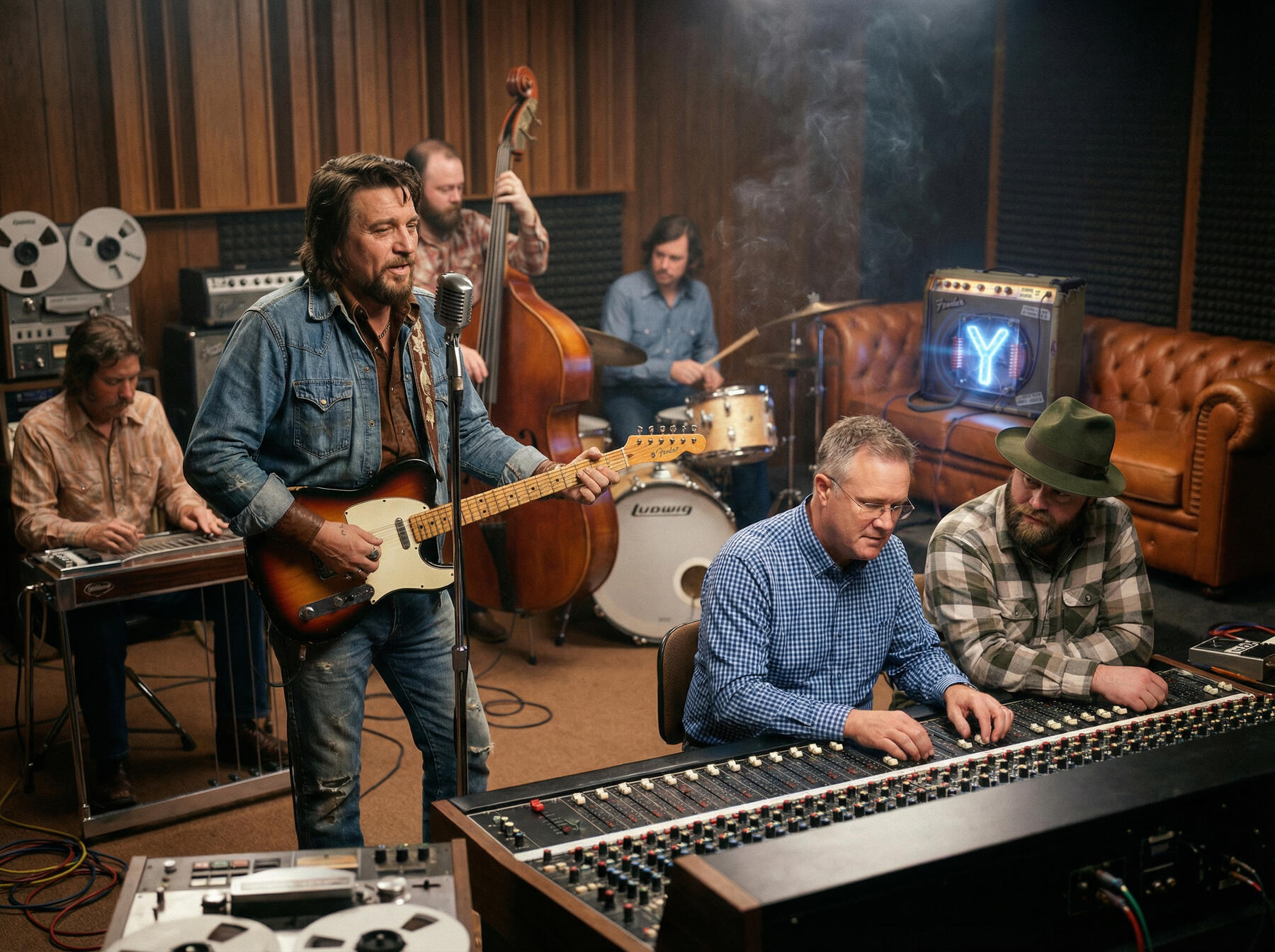
Honky-Tonk Time Machine: Nashville, 1972
RCA Studio B
Featuring Waylon JenningsBlake reached down and adjusted the dials, the tubes beginning to glow as the current built. “Nashville. Nineteen seventy-two,” he said, glancing at Dave. Dave tightened his grip on the neck of his guitar as the low hum deepened into a steady vibration that ran up their arms and into their chests. The room around them flickered like an old film reel burning at the edges. The air smelled suddenly of hot dust and ozone, then shifted to something thicker—cigarette smoke and summer humidity. The floor beneath their boots felt solid one second and weightless the next, as if the years themselves were sliding past in reverse. When the vibration settled and the light steadied, the sound of a pedal steel drifted faintly through the air. They were standing on Music Row, 1972, just in time to witness Waylon Jennings walk into a Nashville studio and decide what his sound was going to be.The afternoon heat hung over Music Row as Blake and Dave stepped into RCA Studio B, drawn by the sound of a playback echoing down the hallway. Inside the control room stood Waylon Jennings, listening intently as the final notes of a take drifted through the speakers. The track was polished—strings swelling gently behind his voice, background vocals tucked neatly into the chorus. It was smooth, professional, and carefully constructed.Waylon removed his headphones slowly and set them on the console. He kept his eyes on the studio floor beyond the glass, where the musicians waited. After a long moment, he spoke evenly. He said it wasn’t his band.One of the producers leaned back in his chair and calmly explained the arrangement. These were Nashville’s top session players. The added strings would broaden the song’s appeal. This was how hits were built. The system worked. It was the Nashville Sound!Blake and Dave stood along the back wall, watching the exchange. They could see that this was not simply about instrumentation; it was about identity. Waylon wasn’t arguing about notes. He was deciding whether to accept a version of himself that felt safer than the one he heard in his head.
Dave stepped forward and asked what the song sounded like to him before anyone else touched it. Waylon answered without hesitation. He said he heard his own band playing it—leaner, rougher, without the extra polish. Blake followed quietly, telling him that if that was the sound he heard, then that was the record he ought to make.The producer responded with reason and reassurance. There was risk in abandoning a formula that consistently produced radio success. Waylon listened, arms folded, absorbing the weight of it. He wasn’t angry. He wasn’t dramatic. He was measuring the cost.Blake spoke again, steady and practical. If he recorded it their way, he might gain a hit. If he recorded it his way, he would keep himself. The room fell silent after that. The tape reels hummed softly, waiting for instruction.Waylon pushed his chair back and walked onto the studio floor. He called to the musicians and told them they were going to try it again. When the producer objected, Waylon answered calmly. It would be his band and his session. There was no raised voice, no theatrical gesture—just certainty.
The strings were set aside. The room was rearranged. Guitars plugged directly into amplifiers. The musicians shifted from careful precision to something more instinctive.When they rolled tape again, the difference was immediate. The rhythm section leaned forward instead of holding back. The guitars carried edge and texture. Space opened up in the arrangement, and Waylon’s voice sat in the middle of it—uncovered and confident. It did not sound manufactured. It sounded owned.Playback filled the control room once more. No one rushed to analyze it. The sound spoke clearly enough. Waylon turned slightly toward Blake and Dave and asked if that felt right. Dave answered that it sounded like him. Waylon gave a small nod, as if that settled the matter.Later, standing outside the studio as the session continued inside, Blake reflected that Waylon hadn’t fought loudly for his way. Dave observed that he hadn’t needed to. The strength came from knowing what he heard and refusing to trade it for comfort.As the low electrical hum waited nearby, ready to pull them back to their own time, Blake and Dave carried something with them. They had witnessed that real change does not always arrive with confrontation. Sometimes it begins in a quiet studio, when a man listens to a polished version of himself and calmly decides he would rather risk failure than surrender his sound.